





CRCC Lands China's Largest Outbound Order in Years: A $5 Billion Aircraft Hangar Complex in Dubai That Will Double Global MRO Capacity
This article contains AI assisted creative content
HIGHLIGHTS
-
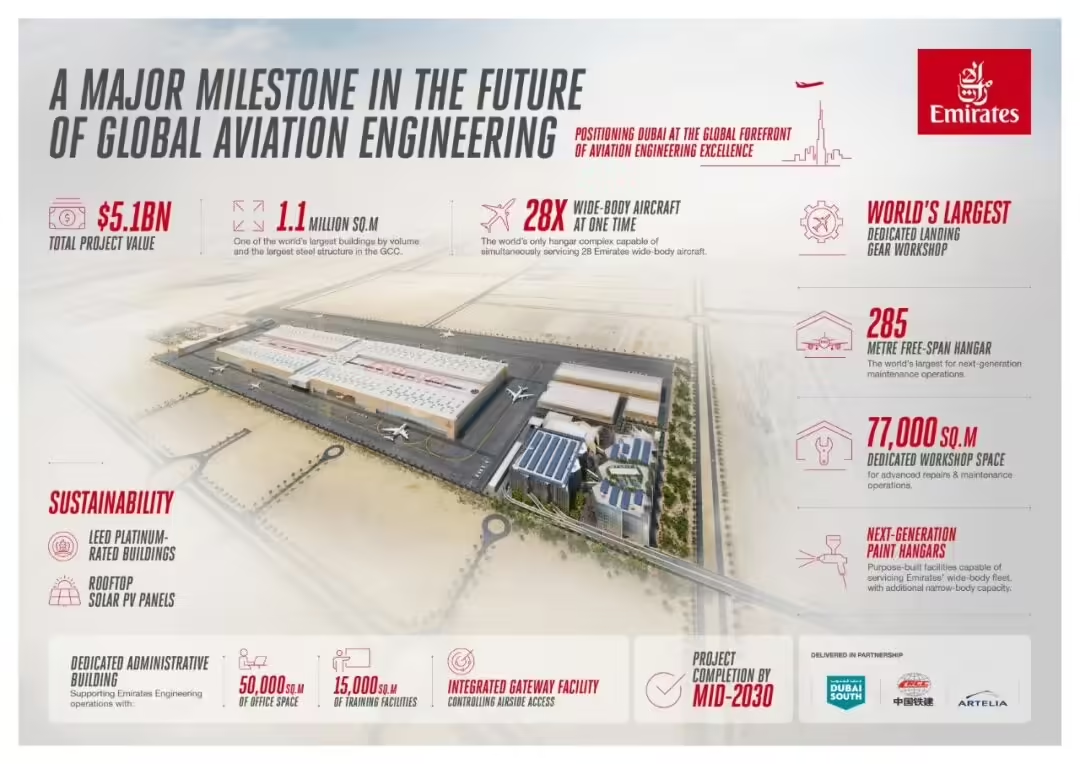
China Railway Construction Corporation (CRCC) signed the largest overseas contract by a Chinese firm in recent years: a Dubai aircraft maintenance hangar complex valued at over $5 billion
-
Total floor area of 1.21 million square metres — roughly 170 football pitches — can accommodate 28 wide-body aircraft simultaneously, double the capacity of the world's largest operating hangar
China Railway Construction Corporation broke ground on May 18 on the Emirates Airline Engineering Centre, a maintenance, repair, and overhaul facility in Dubai World Central that will, upon completion, become the largest civil aviation hangar complex ever built. The contract, valued at over $5 billion, is the largest overseas order secured by a Chinese enterprise in recent years.
The numbers are calibrated to be read against the global fleet. The complex will provide 1.21 million square metres of floor area — the equivalent of 170 standard football pitches — and will be capable of housing 28 wide-body aircraft simultaneously. That is twice the capacity of the largest MRO hangar currently in operation anywhere in the world. The facility sits inside the footprint of the under-construction Al Maktoum International Airport, designed for an eventual annual passenger throughput of 260 million and cargo capacity of 12 million tonnes — five times the scale of the current Dubai International Airport.
The Column-Free Hangar: An Engineering Decision With a Commercial Payoff
The technical specification that matters most commercially is the 285-metre clear span of the hangar bays. The entire maintenance floor will be column-free, an arrangement that sounds architectural but is in fact operational. When a hangar is interrupted by structural columns, maintenance workflows must route around them. Engine replacement, wing inspection, landing-gear removal — each procedure inherits the geometry of the building. A column-free space removes that constraint. Aircraft can be positioned for optimal workflow. Tasks that would otherwise be sequential can run in parallel. The result, in airline economics, is shorter ground time per aircraft.
The standard to which this is being built raises the execution risk. The project is designed to meet European, American, and international aviation standards, applying whichever is most stringent at each point. It must also achieve LEED Platinum certification, the highest tier of the US green building rating system. For a desert facility with eight hangars and two paint shops operating simultaneously, the energy and water performance thresholds that LEED Platinum demands are not marginal.
16 Systems, One Building
The mechanical and electrical integration is specified at a scale uncommon even for large infrastructure projects. The facility will run 16 major systems — dockage, power supply, fuel handling, fire suppression, and security among the aviation-specific ones, plus an automated materials-handling system for the maintenance workshops. The interfaces between these systems and the operational tolerances required for simultaneous aircraft maintenance produce an integration problem that the project team must resolve during construction rather than during commissioning.
The hangar doors alone illustrate the physical challenges. Each bay will be fitted with steel truss beams spanning 285 metres, weighing roughly 2,000 tonnes apiece, hoisted to a height of 45 metres in a single lift. Eight such installations are required, plus two paint-shop hangars, all being built in parallel on a site where summer ground temperatures hit 50 to 60 degrees Celsius, sandstorms interrupt outdoor work, and the diurnal temperature swing stresses both materials and machinery.
What the Contract Represents
For CRCC, a state-owned infrastructure conglomerate better known for railways and heavy civil engineering, the Dubai hangar project marks an entry into a specialised segment — aviation MRO infrastructure — that is dominated by a small number of international engineering and construction firms. The contract size and the technical specifications signal that CRCC is now competing in this segment at its highest end, and that the client — Emirates Airline, which operates the world's largest fleet of Airbus A380s and Boeing 777s — has placed a bet on a Chinese contractor to deliver a facility on which its fleet availability will depend.
For the broader pattern of Chinese outbound contracting, the Dubai order is a data point that suggests the mix is shifting. The projects that won headlines in earlier Belt and Road phases — ports, railways, power plants — are being joined by high-specification commercial facilities for blue-chip clients in competitive markets. The bid that won this contract was priced, but it was also assessed against Eurocodes, LEED criteria, and aviation-specific operational requirements. The construction phase that began on May 18 will test whether the execution matches the tender.


































First, please LoginComment After ~