





Unlocking Trade Opportunities in Africa (1)
Africa is emerging as one of the world’s most dynamic trade regions, driven by rapidly growing national markets and abundant natural resources. A young and increasingly tech‑savvy population is fuelling the next wave of consumption, while diversifying supply chains and accelerating digital adoption are opening new commercial pathways across the continent. These shifts are creating powerful opportunities for Hong Kong businesses.
The continent’s rich endowment of mineral resources and robust agricultural outputs align closely with Hong Kong’s strengths in sourcing, logistics and re‑export services. At the same time, Africa’s expanding consumer base is driving strong demand for high‑quality, value‑for‑money goods. For Hong Kong, opportunities are particularly promising in manufactured products, processed materials and high value telecommunications equipment, especially mobile phones and computers, which continue to drive Hong Kong’s export growth as African economies move decisively towards a more connected, digital future.
Key Economic Characteristics
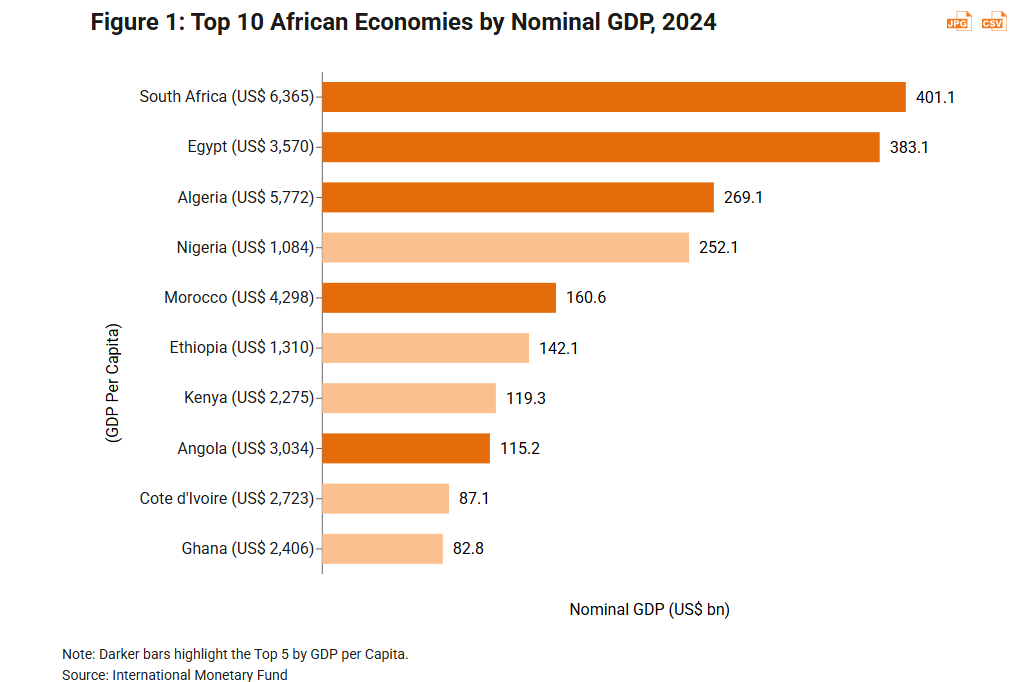
Home to 1.5 billion people, Africa accounts for 19% of the global population and, by 2050, that figure is projected to grow by 63% to 2.5 billion, equivalent to 26% of the global population [1]. The continent spans 54 countries, covering North Africa and the diverse regions of Sub‑Saharan Africa, including Central, East, West, and Southern Africa. Its combined economy is valued at US$2.9 trillion, while average annual income per person remains low at US$2,000, masking wide disparities between individual markets (see Figure 1). Among the largest African economies, South Africa, Algeria and Morocco lead per‑capita GDP with levels more than twice the continental average.
In 2024, Africa’s economy expanded by 3.4%, outperforming the global average. Furthermore, the International Monetary Fund expects this momentum to continue, projecting average growth of 4.4% over the next five years, supported by ongoing fiscal reforms and improving macroeconomic stability [2].
Regional Economic Diversity and Resource Endowments
Africa holds a vast number of resource‑rich countries, making it one of the most resource‑endowed regions in the world. It has extensive deposits ranging from precious stones and metals to mineral fuels, forming a critical foundation for global supply chains.
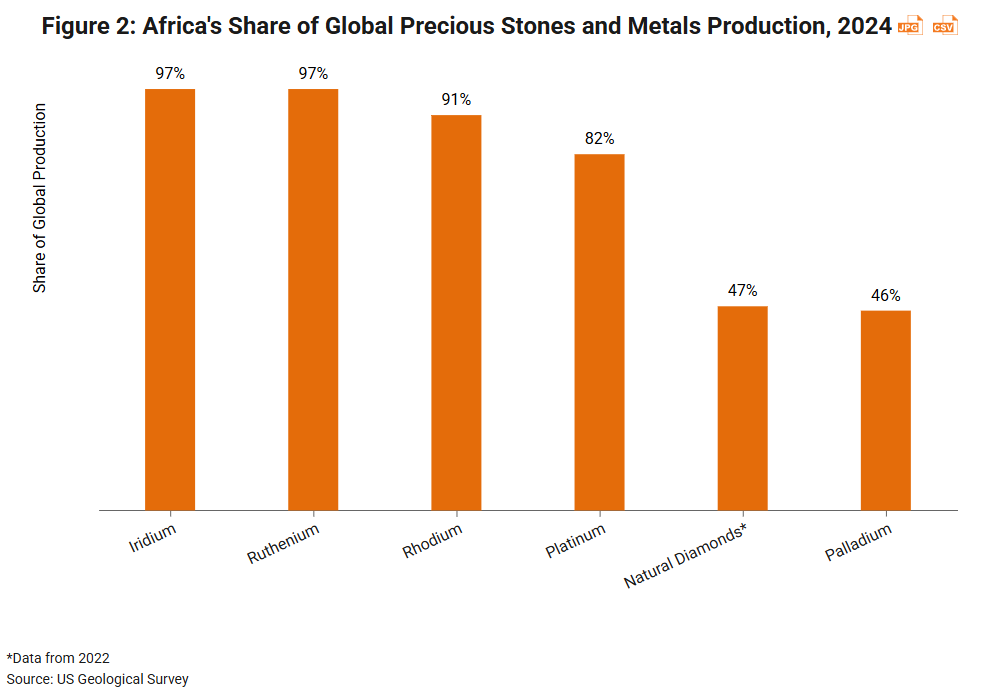
The continent is the world’s leading producer of natural diamonds, supplying about half of global output, with Botswana (49% of Africa’s total) in Southern Africa and Angola (22%) in Central Africa serving as the primary contributors in 2022. South Africa plays a central role in supplying platinum group metals, which are used across industries such as automotive manufacturing and advanced electronics. Together with Zimbabwe, they produced 82% of the global platinum supply, 46% of palladium and more than 90% of the remaining metals in this group (see Figure 2).
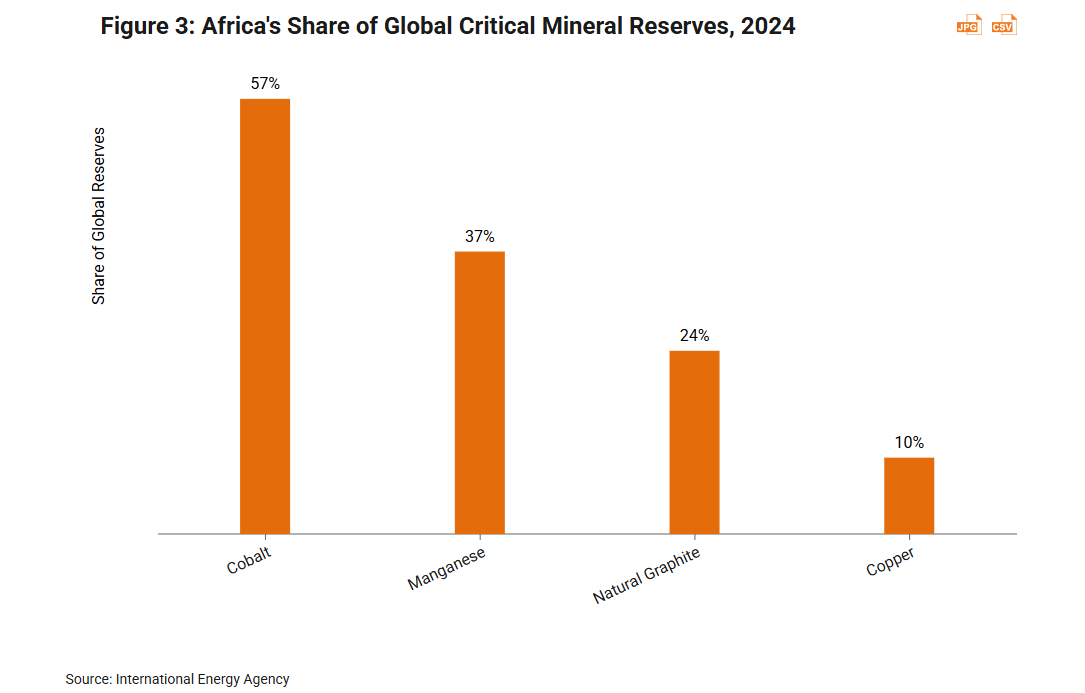
Beyond precious stones and metals, Africa is an essential source of minerals required for global energy transitions, including those used in the production of electric vehicles (EV) (see Figure 3). The Democratic Republic of the Congo is the principal supplier of cobalt and copper, South Africa dominates manganese, while Mozambique and Madagascar lead in natural graphite.
Alongside mining and quarrying, agriculture continues to play a major role across Africa. It remains the leading source of employment in more than 20 African economies [3], with each cultivating crops suited to its climate. In West Africa, Cote d’Ivoire and Ghana stand out as the world’s top cocoa producers, supplying 44% and 14% of global output in 2024 [4], respectively. In East Africa, Kenya and Ethiopia are major producers and exporters of coffee and tea, which continue to support both regional livelihoods and global markets.
Africa’s vast geographic scale, combined with the wide dispersion of its resource endowments, has long made the efficient transportation of goods central to economic activity across the continent. Consequently, Africa’s economic structure has historically been anchored in natural resource extraction and agriculture, supported by transport, logistics and trade services that link markets.
However, this pattern is gradually shifting. Modern services are expanding in markets such as Egypt, Kenya and Nigeria, with information and communication technology and financial services posting double‑digit growth over the past decade. This reflects the continent’s accelerating digital transformation, as rising internet connectivity and mobile penetration fuel demand for technology enabled services.
Unique Demographics Drive Modernisation
Africa’s digital transformation is driven by a young and adaptive population. With a median age of 19.2 and mobile penetration at 47%, many economies are advancing through mobile‑led development. Looking ahead, the Global System for Mobile Communications Association [5] projects an additional 205 million people will subscribe to mobile services by 2030, raising the penetration rate to 53%.
This projection is supported by the central role mobile phones play across the continent. They have become indispensable tools for communication, banking and an expanding range of services. As demand for these services continues to rise, mobile adoption is expected to accelerate, reinforcing the outlook for strong mobile subscriber growth.
E‑commerce exemplifies how mobile led digital transformation is reshaping African economies. Online retail has become increasingly accessible through improvements in mobile connectivity and digital infrastructure. Supported by rising mobile usage, the number of e commerce users tripled from 139 million in 2017 to a projected 520 million in 2025, about one‑third of the continent’s population, according to the United States International Trade Administration [6]. Major markets such as South Africa, Nigeria and Egypt continue to lead this growth, as expanding digital ecosystems accelerate consumer adoption. Together, these trends are reshaping consumption patterns and enabling more Africans to participate in regional and global commerce.
[1] Source: United Nations - Data Portal Population Division
[2] Source: INTERNATIONAL MONETARY FUND - REGIONAL ECONOMIC OUTLOOK - SUB-SAHARAN AFRICA
[3] Source: WORLD BANK GROUP - Employment in agriculture
[4] Source: AFREXIMBANK - Implications of current Cocoa Price Hikes on African Trade and Macroeconomic Performance
[5] Source: GSMA - The Mobile Economy Africa 2025
[6] Source: INTERNATIONAL TRADE ADMINISTRATION - The Rise of E-commerce in Africa






























First, please LoginComment After ~