





China Expands Services Sector Opening-Up Pilot Program to Nine Additional Cities
China is extending its services sector opening-up pilot program to nine new cities, signaling a continued push for high-level market liberalization and operational transparency in strategically important urban centers. The Ministry of Commerce announced the initiative on January 9, 2026, outlining comprehensive pilot tasks tailored to each city’s industrial and logistical strengths.
The nine cities—Dalian, Ningbo, Xiamen, Qingdao, Shenzhen, Hefei, Fuzhou, Xi’an, and Suzhou—will implement 159 pilot measures in areas including telecommunications, financial services, healthcare, and logistics. The Ministry of Commerce emphasized integrated execution, adapting previously developed tasks for other pilot zones while incorporating three new measures specific to these cities, enhancing efficiency and consistency in program rollout.
Each city is encouraged to pursue differentiated strategies based on local conditions:
-
Dalian: Leveraging its role as Northeast Asia’s international shipping hub, Dalian will strengthen logistics corridors and enhance export credit insurance services for software exports.
-
Ningbo: Building on advanced manufacturing and cross-border trade strengths, the city will support the standardized growth of bonded maintenance services and streamline lithium battery export procedures.
-
Xiamen: Utilizing its key industrial parks, Xiamen will pilot offshore computing facilities and explore customs facilitation for imported research-use goods.
-
Qingdao: Focused on modernizing its maritime industry, Qingdao will promote marine technology innovation and trial “destination-free” cruise itineraries.
-
Shenzhen: As a core demonstration zone for reform, Shenzhen will upgrade free trade account functions and test electronic bill-of-lading applications in shipping trade.
-
Hefei: Leveraging technology and industrial innovation, Hefei will deepen reforms in the scientific services sector to enhance regional integration.
-
Fuzhou: Supporting cross-strait cooperation, Fuzhou will strengthen people-to-people exchanges, trade facilitation, and bilateral industrial collaboration, including with Indonesia.
-
Xi’an: Integrating into the Belt and Road framework, Xi’an will explore railway consignment property reforms while building nationally influential technology innovation centers.
Suzhou: Emphasizing advanced manufacturing and modern services convergence, Suzhou will pilot the import of R&D-specific biomedical materials and develop mechanisms for efficient, secure cross-border data flows.
TWO
For foreign investors, multinational service providers, and financial institutions, these measures offer enhanced predictability in regulatory and operational environments. By defining clear pilot tasks, facilitating logistics and customs processes, and promoting innovation-oriented infrastructure, the program reduces operational friction and supports cross-border transactions. Cities like Shenzhen, Dalian, and Ningbo, in particular, provide tangible entry points for companies seeking to scale services operations, engage in technology-enabled trade, or leverage emerging platforms in finance, healthcare, and logistics.
Since the program’s launch in 2015, China has steadily expanded its institutional opening-up, combining legal standardization with market-oriented governance. The addition of these nine cities underscores the country’s continued commitment to creating a transparent, business-friendly ecosystem where foreign service enterprises can operate efficiently and confidently.
THREE
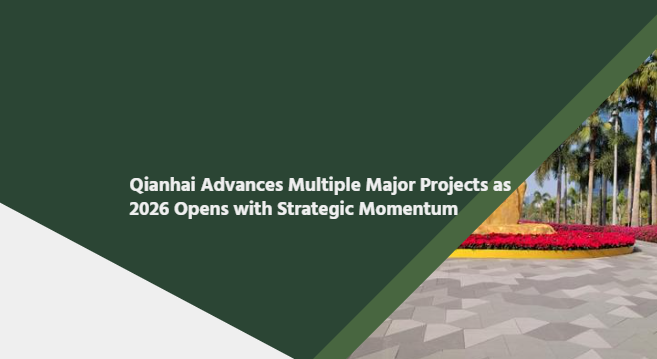
Sixteen major projects are scheduled to be commissioned this year, encompassing cultural, technological, and public service functions.
The Qianhai Museum, designed as a “Tree of Civilization and Beacon of the Times,” integrates coastal and urban characteristics in a site of 32,400 square meters with 126,000 square meters of built space. Construction has topped out, façade work is nearly complete, and mechanical and interior fit-out is underway, with trial operations planned for October 2026. For international companies, such cultural infrastructure enhances talent attraction, executive relocation feasibility, and long-term asset value in the district.
The Qianhai Shenzhen–Hong Kong Youth Innovation Hub (South Zone) further illustrates the zone’s integrated approach. Covering nearly 210,000 square meters, the 188-meter-high complex combines research offices, innovation service centers, residential facilities, commercial spaces, and transport links. Completion is expected in December 2026, providing an operationally ready platform for cross-border innovation ventures, with co-location benefits for financiers, legal advisors, and HR professionals supporting Hong Kong–Shenzhen entrepreneurial activity.





























First, please LoginComment After ~